May Day Manifesto 1968 by Raymond Williams
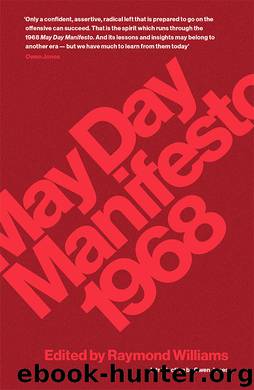
Author:Raymond Williams
Language: eng
Format: epub
Publisher: Verso Books
29. Backlash in Europe
Thus our indictment of the Cold War cannot be separated from our indictment of the new imperialism. Both co-exist; both are intricately related: it will be death if both should fully coincide. Moreover, this imperialism is not only something which is out there: thousands of miles away in Latin America or Asia. Because the main arena has passed away from Europe it does not mean that Europe is no longer centrally involved. Europe received, in 1967, a brutal reminder of the cumulative effects on a nation’s political and social life of twenty years of subordination to Cold War priorities. In 1947, in the midst of a bitter civil war which British armed opposition to the resistance movement had done much to provoke, Britain handed over economic and military responsibility for Greece to the United States. This provided the occasion for the declaration of the ‘Truman Doctrine’ which has been used in justification for a score of interventions in succeeding years:
One way of life is based upon the will of the majority, and is distinguished by free institutions, representative government, free elections, guarantees of individual liberty, freedom of speech and religion and freedom from political repression. The second way of life is based upon the will of a minority forcibly imposed upon the majority. It relies upon terror and oppression, a controlled press and radio, fixed elections, and the suppression of personal freedoms.
Whatever plausibility this doctrine held in 1947 dissolved into ironies as tanks encircled Athens in April 1967. For, in the previous twenty years, American ‘aid’ ($1,238 million in military aid between 1946 and 1958) had served to bolster a series of corrupt and anti-democratic regimes. This aid provided the real basis upon which the military elite, traditionally the stronghold of Greek reaction, could strengthen its power: a military force 180,000 strong, equipped by the ‘free West’, was built up within a nation of nine millions. Whether the colonels seized power in Greece at the instigation of the C.I.A. or whether United States diplomats would have preferred a more ‘democratic’ royalist facade to replace Papandreou’s liberalizing government is not a point of substance. What is substantial evidence is, first, the political consequences of successive transfusions of ‘aid’ to the controllers of the military apparatus; second, the complaisance of the United States and of Britain in the aftermath of the coup. Despite protests from the Scandinavian nations, both military aid to Greece and NATO membership have been sustained. In Britain a Labour government has shown more distaste for British demonstrators at the Greek Embassy in London than they have for the Greek colonels who are holding thousands upon the bleak prison islands without trial.
Less than a year before the colonels’ coup, the U.S. News and World Report (8 August 1966) furnished us with another irony:
Vietnam is viewed [by President Johnson] as the ‘Greece’ of South-East Asia. Just as Europe was unable to relax and forge ahead after World War II until after Red aggression had been stopped in
Download
This site does not store any files on its server. We only index and link to content provided by other sites. Please contact the content providers to delete copyright contents if any and email us, we'll remove relevant links or contents immediately.
| Anthropology | Archaeology |
| Philosophy | Politics & Government |
| Social Sciences | Sociology |
| Women's Studies |
The Secret History by Donna Tartt(19103)
The Social Justice Warrior Handbook by Lisa De Pasquale(12197)
Thirteen Reasons Why by Jay Asher(8919)
This Is How You Lose Her by Junot Diaz(6894)
Weapons of Math Destruction by Cathy O'Neil(6284)
Zero to One by Peter Thiel(5808)
Beartown by Fredrik Backman(5767)
The Myth of the Strong Leader by Archie Brown(5513)
The Fire Next Time by James Baldwin(5454)
How Democracies Die by Steven Levitsky & Daniel Ziblatt(5225)
Promise Me, Dad by Joe Biden(5157)
Stone's Rules by Roger Stone(5091)
A Higher Loyalty: Truth, Lies, and Leadership by James Comey(4966)
100 Deadly Skills by Clint Emerson(4931)
Rise and Kill First by Ronen Bergman(4797)
Secrecy World by Jake Bernstein(4756)
The David Icke Guide to the Global Conspiracy (and how to end it) by David Icke(4723)
The Farm by Tom Rob Smith(4517)
The Doomsday Machine by Daniel Ellsberg(4493)
